
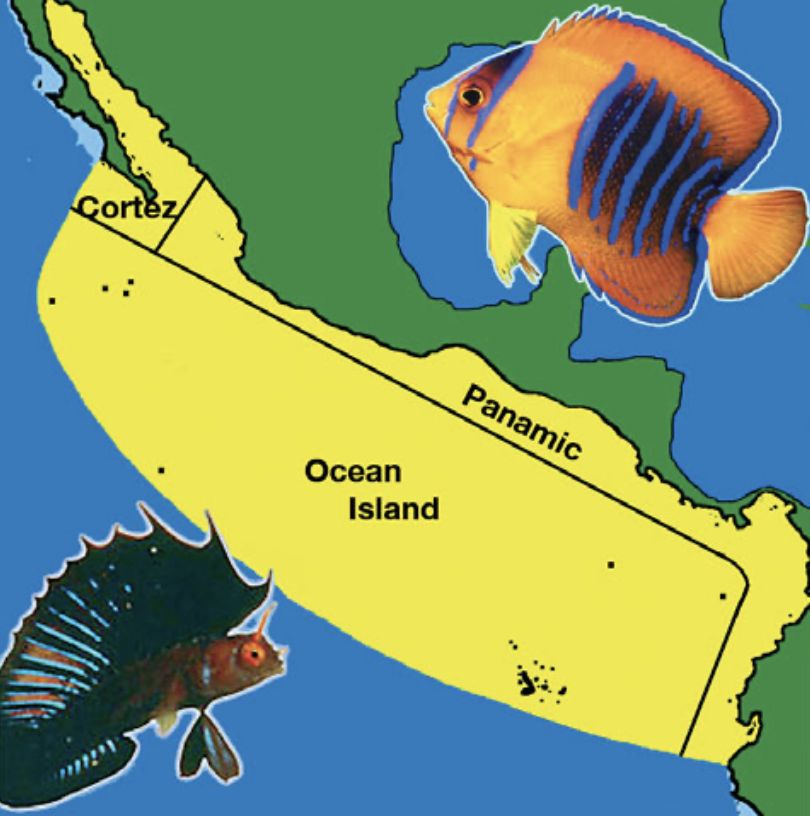
In the literature, the large-scale biogeographic zones in the Tropical Eastern Pacific (TEP) are often disputed, sometimes defined by physical barriers (such as in Hastings, 2000), and more recently, defined by temperature gradients and biological limitations (such as in Robertson and Cramer, 2009).
No matter which way you slice it, however, there is evidence that the Islas Marias Biosphere Reserve (located in the central Mexican Pacific, ~90km offshore of Nayarit state) facilitates the transport of marine species throughout the TEP. In fact, the Archipelago seems to be a link between northern and southern coral populations (López-Pérez et al., 2015), and, like other archipelagos in the TEP, appears to serve as a biogeographic “stepping-stone” for fish and invertebrate larvae dispersal (Ketchum and Reyes-Bonilla 1997).
In order to assess the fish biodiversity and abundance at Islas Marias — research that was severely lacking in part due to the fact that the Federal Penitentiary of Mexico was located on Isla Maria Madre from 1905-2019, see my introduction to Islas Marias research) — I analyzed a total of 131 Baited Remote Underwater Video (BRUV) surveys that the field team deployed over all four islands during three expeditions to the islands in 2018 (see the field report).
Here’s what we learned about the biogeographic role of Islas Marias for marine species in the TEP as a result of the BRUV surveys:
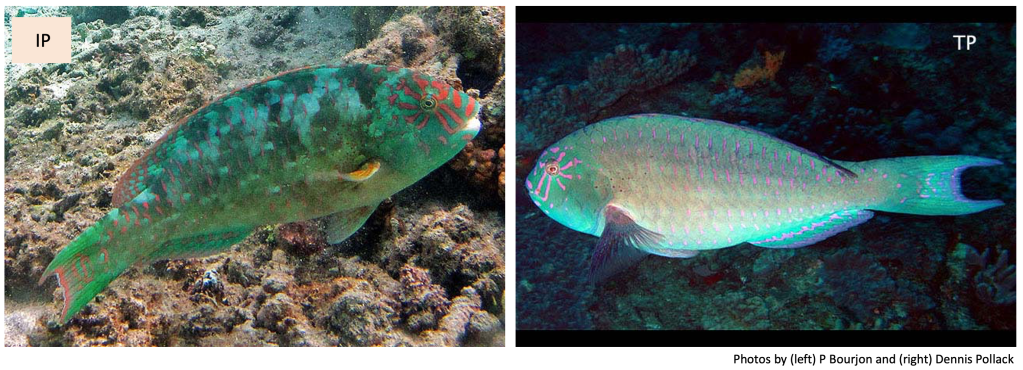
- After spotting the starry-eyed Caroline’s parrotfish (Calatomous carolinus) on four of the BRUV surveys, we were able to confirm its presence at Islas Marias, extending the range of the species closer to the Mexican mainland. C. carolinus exists throughout the South Pacific, and has been spotted at the Galapagos and Revillagigedo Islands as well as the tip of Baja — but this is the first time it has been spotted so close to the mainland. This suggests that Islas Marias may be the first landing place of species undergoing range expansions destined to bring them closer to coastal communities.
- The extension of C. carolinus into all three provinces within the TEP suggests that the biogeographic boundaries may be softening as more tropical species move northward.
- Additionally, it supports prior evidence that Islas Marias serves as a stepping stone for fish species migrating throughout the TEP.
The results and conclusions summarized in this post are a part of a larger paper currently in review for publication by the editors of Ciencias Marinas. Permission is required to reprint this information. Please email brittany.tholan@gmail.com with any inquiries. The current citation for this work is as follows:
Brittany Tholan1, Peter Carlson1, J.J. Adolfo Tortolero-Langarica2, James T. Ketchum3, Abel Trejo-Ramírez3, Erendira Aceves-Bueno4 and Jennifer E. Caselle1, “The biodiversity of fishes at the Islas Marias archipelago, Mexico as determined by baited remote underwater video,” in progress.
1Marine Science Institute, University of California, Santa Barbara, Santa Barbara, CA
2Tecnológico Nacional de México / IT Bahía de Banderas, Bahía de Banderas, Nayarit, México
3Pelagios-Kakunja-Marine Conservation, La Paz, Baja California Sur, México
4The Nicholas School of the Environment, Duke University, Beaufort, NC
5Centro de Investigaciones Biológicas del Noroeste, La Paz, Baja California Sur, México
 Brittany Foster